
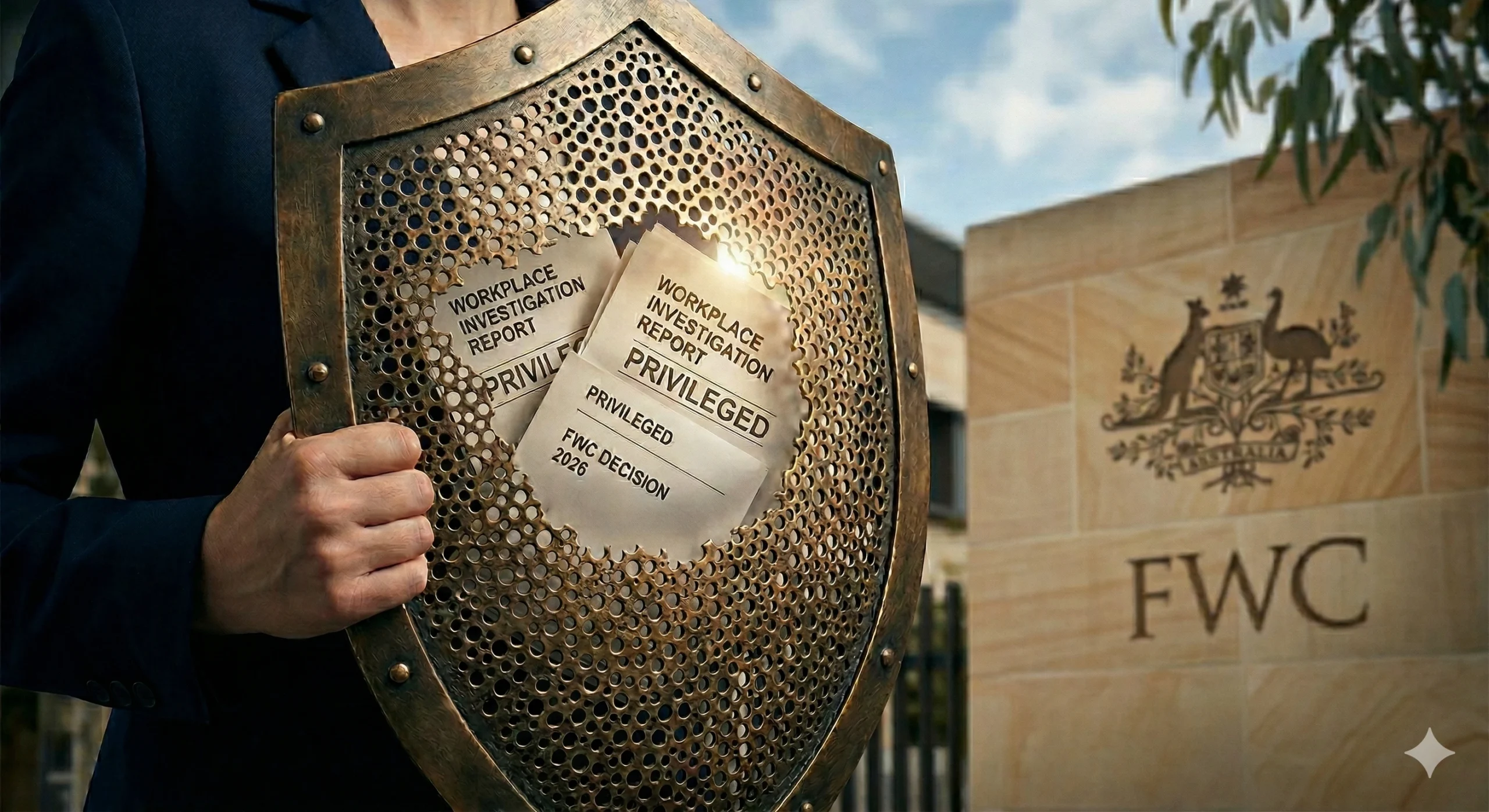
In the complex ecosystem of Australian industrial relations, the workplace investigation has long been a critical tool for resolving conflict, addressing misconduct, and mitigating risk. However, recent developments in March 2026 have sent a clear message to HR professionals and business owners: the traditional “shield” of legal professional privilege is more porous than many once thought.
For years, many employers operated under the assumption that if a workplace investigation was commissioned through a law firm or overseen by legal counsel, the resulting report was automatically protected from disclosure. A landmark decision by the Fair Work Commission (FWC) on March 13, 2026, has fundamentally challenged this practice, reminding the business community that privilege is a narrow protection, not a broad immunity.
The March 2026 FWC Ruling: The “Dominant Purpose” Test
In a recent case that has put the national HR sector on notice, the FWC rejected an employer’s claim of legal advice privilege over an external investigation report. Despite the employer’s argument that the report was commissioned to seek legal guidance, the Commission ordered its production.
The crux of the decision rested on the “dominant purpose” test. The FWC found that while obtaining legal advice may have been a purpose, it was not the dominant purpose at the time the investigator was engaged. Instead, the Commission viewed the investigation as a standard fact-finding mission intended to satisfy internal policy requirements rather than a strategic tool for litigation prep.
This serves as a vital reminder: simply involving a lawyer does not “cloak” a factual investigation with privilege. If the primary driver for the investigation is to determine whether a policy has been breached or to manage an internal dispute, the resulting document may be discoverable in future litigation.
The New Risk Environment: NSW WHS Amendments
This shift in transparency comes at a time of heightened regulatory pressure. As of March 1, 2026, the Industrial Relations and Other Legislation Amendment (Workplace Protections) Act 2025 (NSW) has officially expanded the powers of registered industrial organisations (unions). They are now empowered to initiate civil penalty proceedings for contraventions of work health and safety (WHS) laws, particularly concerning psychosocial hazards.
With unions now acting as a secondary “regulator,” the scrutiny on how a business investigates claims of bullying, harassment, or workplace stress is unprecedented. A poorly handled or inadvertently disclosed investigation report could now serve as the primary evidence for a union-led prosecution. The margin for error in how these reports are drafted and protected has narrowed to almost zero.
The Pitfall of Over-Disclosure
Another key takeaway from recent March 2026 updates is the danger of waiving privilege through “over-disclosure.” Employers often feel a natural urge to be transparent with complainants and respondents by sharing the details of an investigator’s findings to justify a disciplinary outcome.
However, the legal consensus is tightening: disclosing anything more than the high-level outcome (e.g., “the allegation was substantiated”) can constitute a waiver of privilege. If you share the evidentiary basis of a finding—such as specific witness statements or the investigator’s reasoning—you may have effectively “opened the gates,” allowing the entire report to be subpoenaed by the opposing side.
Dealing with the “Ungovernable” Modern Worker
The landscape is also being reshaped by technology. In a fascinating side-note from the FWC on March 20, 2026, the Commission upheld the dismissal of an employee described as “ungovernable.” The worker had bombarded their employer with a barrage of dense, repetitive emails—generated by AI—to reignite grievances that had already been resolved.
This case highlights a new frontier for workplace investigators: the “AI-assisted grievance.” Investigators must now be equipped to distinguish between genuine, human-led complaints and tactically generated content designed to overwhelm HR systems. The FWC’s support for the employer in this instance suggests that while the “right to disconnect” and flexible work remain hot topics, “obstinate” conduct facilitated by technology will not be shielded.
Strategic Recommendations for 2026
To navigate this “sieve-like” environment, Australian businesses should adopt three key strategies:
-
Define Purpose at the Outset: Before the first interview occurs, document the primary reason for the investigation. If it is truly to obtain legal advice regarding potential litigation, this must be explicitly stated in the engagement letter and reflected in every subsequent communication.
-
Separate the “Facts” from the “Advice”: Consider a two-stage process where a factual summary is prepared (which may be discoverable) and a separate legal analysis is provided by counsel (which is more likely to remain privileged).
-
Audit Your WHS Frameworks: Given the new union powers in NSW and similar trends in other states, ensure your “psychosocial hazard” registers are up to date. An investigation that fails to address the systemic cause of a hazard is now a significant liability.
Conclusion
As we move through 2026, the era of the “confidential” investigation report is fading. Transparency is the new default. For the team at Jo Lasers and our clients, this means that the quality of the investigation process is now the only true protection.
In a world where privilege can be waived with a single email or denied by a Commission’s ruling, businesses must focus on conducting investigations that are procedurally fair, factually robust, and legally sound from day one. The “shield” might be thinner, but a well-executed investigation remains the best defense against the rising tide of workplace litigation.